Get instantly better baking results with stainless steel mixing bowls. Check out this simple solution for every cooking need.
Tchiki Davis, M.A., Ph.D.
*This post may contain affiliate links. If you click and make a purchase, we may earn a small commission at no extra cost to you.
Every ingredient you combine for baking happens in a mixing bowl, making these vessels critical tools in your kitchen. Plastic bowls can leach chemicals into your dough and batters, especially when handling warm ingredients or acidic mixtures. Glass bowls, while inert, are heavy and prone to breaking. Ceramic options may contain lead in decorative glazes or crack under temperature changes.
If you're serious about baking healthier treats for your family while reducing toxic exposures, stainless steel mixing bowls represent the gold standard—durable, non-reactive, and completely safe for food contact across all baking applications.
The best stainless steel mixing bowls for bakers combine several essential qualities: food-grade metal that won't leach or react with ingredients, appropriate sizes for various baking tasks, stable bases that won't tip during vigorous mixing, and construction that withstands decades of use. Quality stainless steel bowls work seamlessly for everything from whisking eggs to kneading bread dough, proving bread in a warm oven, and even serving finished goods. They're lightweight yet sturdy, nest for compact storage, and transition from freezer to oven without concern. This comprehensive guide explores why stainless steel mixing bowls deserve their place as essential baking tools, covering the science of stainless steel, real baker experiences, safety considerations, and how to choose the perfect bowls for your baking needs.
The science behind stainless steel mixing bowls begins with understanding the metal itself. Stainless steel is an iron alloy containing at least 10.5% chromium, which creates a passive oxide layer on the surface. This mechanism prevents rust and corrosion—the chromium reacts with oxygen to form chromium oxide, a protective barrier that self-repairs if scratched. This is why the best stainless steel mixing bowls maintain their appearance and integrity through years of heavy use.
Different grades of stainless steel exist, with 18/8 and 18/10 being most common in quality mixing bowls. These numbers indicate the chromium and nickel content (18% chromium, 8-10% nickel). The nickel adds corrosion resistance and creates the lustrous finish bakers appreciate. Understanding these grades helps you identify quality stainless steel bowls that will truly last a lifetime.
One of stainless steel's most valuable properties for bakers is its non-reactive nature. The mechanism involves the stable chromium oxide layer, which prevents the metal from interacting with acidic or alkaline ingredients. When you mix lemon juice, vinegar, buttermilk, or tomato-based ingredients in stainless steel mixing bowls, no metallic taste transfers to your food. No chemical reactions alter your ingredients' properties.
This contrasts with aluminum bowls, which can react with acids, creating off-flavors and discoloring light-colored foods. Copper bowls, while excellent for whipping egg whites, react with most other ingredients. The promise of stainless steel mixing bowls is complete versatility—they safely handle every ingredient and recipe without concern about chemical interactions affecting your baked goods.
Understanding how stainless steel handles temperature extremes reveals its exceptional versatility. The metal's thermal properties allow stainless steel mixing bowls to transition safely from freezer (-20°F) to oven (up to 500°F, depending on construction). The mechanism involves the metal's stable crystalline structure, which doesn't crack, warp, or degrade under temperature stress like plastic or glass alternatives.
For bakers, this temperature range proves invaluable. You can chill dough in the bowl in your refrigerator, use the same bowl to proof bread dough in a warm oven, or create a double boiler by nesting the bowl over simmering water to melt chocolate. The best stainless steel mixing bowls function as multi-purpose tools that adapt to whatever your recipe requires.
The exceptional durability of stainless steel mixing bowls comes from the metal's mechanical properties. Stainless steel resists denting, scratching, and deformation far better than softer metals or plastics. The mechanism involves the alloy's hardness combined with slight ductility—it's strong enough to maintain shape under normal use while flexible enough not to shatter if dropped.
The promise is mixing bowls that literally last generations. Quality stainless steel bowls purchased for your grandmother might still be serving your family today. The material doesn't degrade, absorb odors, stain permanently, or lose structural integrity. This longevity creates remarkable value despite higher initial costs compared to disposable alternatives.

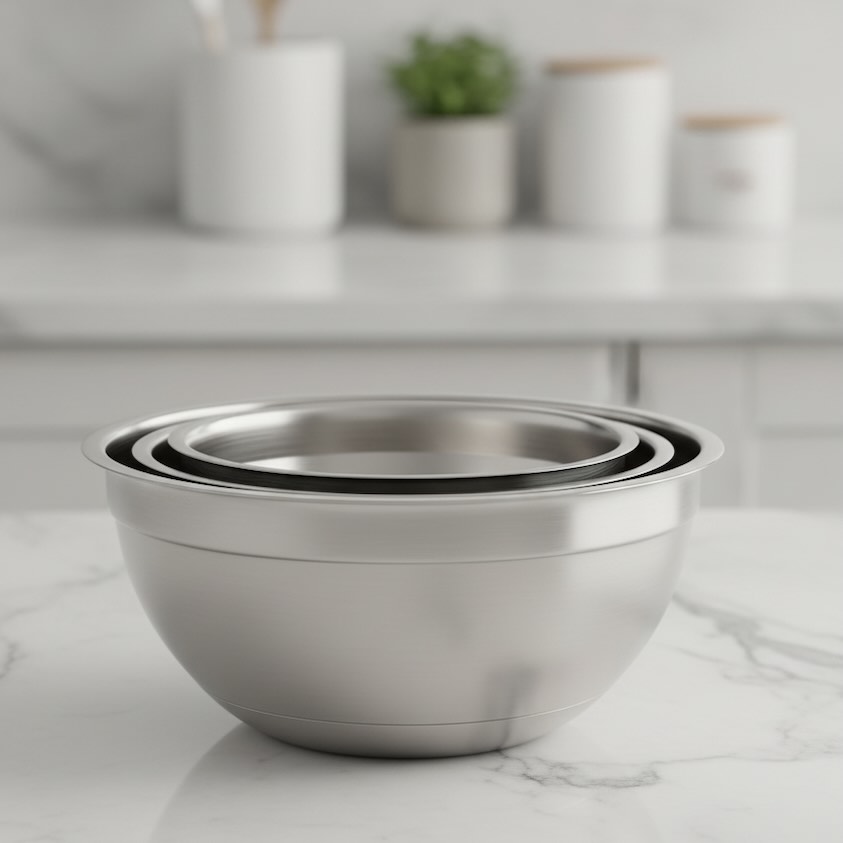
When you handle the best stainless steel mixing bowls, quality is immediately apparent. The metal feels substantial without being excessively heavy. The rim is smooth and rolled, comfortable against your arm during extended mixing. The bowl walls show appropriate thickness—thick enough for durability but not so heavy that the bowl becomes unwieldy when filled with dense dough.
Reviews across Amazon and baking forums consistently mention this tactile quality difference. Bakers describe premium stainless steel bowls as "perfectly balanced," "substantial but not cumbersome," and "professional-grade feel." The immediate results of using quality mixing bowls include more pleasant baking experiences and confidence that your tools match your skills.
The critical performance metric for mixing bowls is how well they function during actual baking tasks. Stainless steel mixing bowls excel across diverse applications. The smooth interior allows dough to release easily during kneading. The stable base prevents tipping when using stand mixer attachments or vigorous hand mixing. The depth accommodates rising dough without spilling over.
Reddit's baking communities share detailed performance experiences. Home bakers report that stainless steel bowls handle everything from delicate meringues to heavy bread doughs flawlessly. The non-reactive surface means sensitive recipes like Swiss meringue buttercream don't pick up metallic flavors. Professional bakers transitioning home universally choose stainless steel mixing bowls because they match commercial kitchen standards.
One practical advantage of the best stainless steel mixing bowls is how they nest for storage. Quality sets are designed with graduated sizes that stack inside each other, consuming minimal cabinet space. This mechanism seems simple but significantly impacts kitchen organization. A 6-piece bowl set occupies barely more space than the largest bowl alone.
Users consistently praise this space efficiency in reviews. Bakers with limited storage appreciate that their complete bowl collection fits in a single cabinet. The nesting design also protects bowls during storage—inner bowls cushion outer ones, preventing scratches. This thoughtful design demonstrates how quality stainless steel bowls meet real-world kitchen needs.
Beyond mixing, stainless steel bowls prove remarkably versatile. Bakers discover their mixing bowls work perfectly for serving salads, storing prepped ingredients, marinating meats, or even creating makeshift double boilers. The immediate results include reduced need for specialized equipment and more efficient kitchen operations.
Key performance observations from baker reviews:
The hands-on experience confirms that the best stainless steel mixing bowls deliver exceptional performance across all baking applications while proving durable enough to truly last a lifetime.

The safety case for stainless steel mixing bowls begins with addressing metal leaching concerns. All metal cookware can theoretically release trace amounts of metal ions into food. However, the mechanism of stainless steel's chromium oxide layer dramatically minimizes this leaching. Studies show that food-grade stainless steel releases negligible metal amounts—far below safety thresholds—even when in contact with acidic foods for extended periods.
The best stainless steel mixing bowls use 18/8 or 18/10 grades specifically formulated for food contact. These non-toxic alloys have extensive safety data confirming they're safe for all food preparation. The chromium and nickel remain bound in the metal matrix rather than migrating into food. This makes stainless steel bowls fundamentally safer than plastic alternatives that can leach endocrine-disrupting chemicals.
One safety concern some bakers have involves nickel content in stainless steel. Nickel is an allergen for approximately 10-20% of the population. However, the mechanism of nickel's incorporation into stainless steel—tightly bound within the alloy—means it rarely causes issues. The chromium oxide layer prevents direct nickel contact with food or skin under normal use.
For individuals with severe nickel allergies, 18/0 stainless steel (chromium but no nickel) provides a safe alternative. This grade appears in some mixing bowls marketed as "nickel-free." For most bakers, standard 18/8 or 18/10 stainless steel mixing bowls pose no concern. The non-toxic nature and minimal leaching make them among the safest options available.
Understanding what stainless steel replaces highlights its safety advantages. Plastic mixing bowls can leach BPA, phthalates, and other chemicals, especially when containing warm or acidic ingredients. Even "BPA-free" plastics often contain replacement chemicals with limited safety data. Melamine bowls, popular for their durability, can release formaldehyde under certain conditions.
Non-toxic stainless steel mixing bowls avoid all these concerns. The inert metal doesn't leach plasticizers, doesn't break down under heat, and doesn't absorb or harbor bacteria in scratches the way plastic does. Glass represents the only other truly inert option, but its fragility and weight create practical disadvantages. The best stainless steel bowls combine glass's safety with superior durability and lighter weight.
Identifying safe stainless steel mixing bowls means understanding certification standards. Food-grade stainless steel meets specific composition requirements set by organizations like the FDA and NSF International. Quality manufacturers clearly state their bowls use food-grade 304 stainless steel (18/8) or 316 stainless steel (higher corrosion resistance). These designations confirm the metal is safe for food contact.
Safety features of quality stainless steel mixing bowls:
Non-toxic stainless steel mixing bowls provide peace of mind that your baking tools aren't introducing chemicals into the treats you lovingly prepare for your family.
When you bake treats for your family, especially children, ingredient purity matters tremendously. But the containers you mix those ingredients in are equally important. Children consume proportionally more food relative to their body weight than adults, making their chemical exposures more impactful. Using the best stainless steel mixing bowls ensures no container-related chemicals contaminate your homemade cookies, birthday cakes, or daily bread.
Family safety extends to teaching children baking skills. Stainless steel bowls are sturdy enough to withstand enthusiastic young bakers, won't shatter if dropped like glass, and don't leach chemicals even when kids forget ingredients in bowls overnight. The non-toxic nature means you can confidently involve children in baking without concern about their safety or chemical exposures.
Many home bakers aspire to professional-quality results. Professional bakers exclusively use stainless steel mixing bowls in commercial kitchens for good reasons. The durability withstands constant daily use. The non-reactive surface never affects flavor. The ability to withstand temperature extremes accommodates any recipe requirement. Bringing this professional standard home elevates your baking capabilities.
The best stainless steel mixing bowls allow home bakers to execute advanced techniques confidently. Creating Swiss meringue requires a bowl that can sit over boiling water safely. Tempering chocolate needs precise temperature control that glass or ceramic compromise. Bread baking benefits from bowls that can proof dough in warm ovens. Professional-grade stainless steel bowls enable these techniques at home.
Choosing appropriate sizes represents a critical decision for bakers. Small bowls (1-3 quarts) work perfectly for whisking eggs, mixing small batches, or holding prepped ingredients. Medium bowls (4-6 quarts) handle most standard recipes—cookie dough, cake batters, and mixing dry ingredients. Large bowls (8+ quarts) accommodate bread dough, large batch baking, or serving at gatherings.
Most bakers find a nested set with 3-5 graduated sizes most useful. This provides appropriate bowls for any baking project without excessive redundancy. Family use benefits from having multiple sizes available—you can prepare several recipe components simultaneously using different bowls from your set.
Stainless steel mixing bowls work beautifully for bakers at every skill level. Beginners appreciate the straightforward care—just wash and dry. The durable material forgives rookie mistakes like using metal utensils or subjecting bowls to temperature extremes. Advanced bakers value the performance characteristics and versatility for complex techniques.
Key usability features for different baker types:
Family use across generations proves sustainable with the best stainless steel mixing bowls. Grandparents pass them to parents who use them with children—true multi-generational kitchen tools that maintain full functionality throughout decades of service.
Stainless steel mixing bowls span considerable price ranges depending on quality, size, and brand. Budget sets cost $15-25 for 3-5 bowls of adequate quality. Mid-range options run $30-50 for better construction and more thoughtful design. Premium professional-grade bowls reach $50-100+ for sets with superior metal thickness, perfect nesting, and silicone bases for stability.
Where to buy affects value significantly. Restaurant supply stores offer professional-quality stainless steel mixing bowls at excellent prices. Amazon carries extensive selection with user reviews validating quality claims. Kitchen specialty stores stock premium brands but at higher markups. Costco occasionally features quality sets at competitive pricing. Smart shopping finds the best bowls at reasonable prices.
Evaluating true value requires calculating cost per use over the bowl's lifespan. Quality stainless steel mixing bowls last 20-30+ years with normal use—essentially indefinitely. If you bake weekly, a $40 bowl set gets used over 1,000 times across 20 years. This works out to approximately $0.04 per use—negligible for a critical baking tool.
The best stainless steel mixing bowls often outlive their owners. Many bakers treasure bowls inherited from parents or grandparents that still function perfectly after 40-50 years. This intergenerational value is unique to quality stainless steel. The initial investment becomes increasingly justified as years pass and the bowls continue performing flawlessly.
The value proposition becomes even clearer when comparing to alternatives requiring replacement. Plastic mixing bowls stain, absorb odors, and crack—typically needing replacement every 2-5 years. If you replace $15 plastic bowl sets three times over 15 years, you've spent $45 for inferior performance. A $40 stainless steel set bought once serves you for life with superior functionality.
Glass bowls occasionally break, requiring replacement. Even careful bakers eventually have accidents. The cost of replacing broken glass bowls over decades often exceeds the single purchase of quality stainless steel mixing bowls. This practical consideration matters significantly for value-conscious bakers.
The difference between budget and premium stainless steel mixing bowls affects satisfaction and longevity. Budget bowls (under $25 for sets) often use thinner metal that dents more easily, may have rougher finishes, and sometimes nest poorly. Premium bowls ($50+) feature optimal metal thickness, mirror-polish interiors, silicone non-slip bases, and precise nesting.
Value maximization strategies for stainless steel bowls:
The price of the best stainless steel mixing bowls represents genuine long-term value. The combination of lifetime durability, superior performance, and complete safety justifies the investment for any baker who values their craft and family's health.
Glass mixing bowls represent the primary alternative for health-conscious bakers. Glass offers complete non-reactivity and allows visual monitoring of layered ingredients or dough development. Pyrex and other tempered glass bowls can safely move from refrigerator to oven. However, glass is significantly heavier than stainless steel, making large bowls filled with dough cumbersome. Breakage risk remains constant—one drop can end a glass bowl's life.
The best stainless steel mixing bowls match glass's safety while excelling in durability and weight. Both materials are non-reactive and non-toxic. Stainless steel wins on practicality—lighter, unbreakable, and typically less expensive. Glass edges ahead for microwave use and visual monitoring. Many bakers keep both, using glass for specific applications and stainless steel for general baking.
Plastic bowls dominate many home kitchens due to low cost and bright colors. However, for health-conscious bakers, plastic presents significant concerns. Plastics leach chemicals, especially when containing acidic or warm ingredients. They stain, absorb odors, scratch easily (harboring bacteria), and eventually crack or warp. Even "food-safe" plastics are relatively toxic compared to inert materials.
Stainless steel mixing bowls vastly outperform plastic across every metric except initial cost and microwave use. The safety advantage alone justifies choosing stainless steel. The durability and performance advantages are substantial bonuses. For bakers prioritizing health and quality, plastic bowls simply can't compete with stainless steel alternatives.
Among stainless steel mixing bowls, several brands have established strong reputations. Cuisinart offers quality sets at reasonable prices—their bowls feature good thickness, smooth interiors, and reliable nesting. Amazon reviews consistently rate their performance highly. FineDine takes a premium approach with mirror-finish interiors, silicone bases for stability, and exceptional nesting precision.
Vollrath represents professional-grade equipment at accessible prices through restaurant supply channels. Their bowls are what commercial kitchens use—extremely durable with optimal thickness. All-Clad produces premium bowls with their renowned attention to detail, though at higher prices. The best stainless steel mixing bowls for your needs depend on budget and preferences.
Comparing Cuisinart to FineDine illustrates choices within the stainless steel category. Cuisinart sets typically cost $25-35 for 3-5 bowls of solid quality. The metal thickness is appropriate, finishes are smooth, and performance satisfies most home bakers. They represent excellent value for quality delivered at moderate pricing.
FineDine bowls cost $40-50 for comparable sets but include upgrades: mirror-polish interiors for easier release and cleaning, silicone bases preventing sliding during vigorous mixing, and more precise nesting. The performance difference is noticeable but perhaps not essential. Your choice depends on priorities:
All represent excellent alternatives to inferior plastic or fragile glass. The best stainless steel mixing bowls are those that match your specific baking habits and budget while delivering the safety and performance all quality stainless steel provides.

The best stainless steel mixing bowls offer compelling benefits that make them essential for serious bakers. The complete non-reactivity ensures no ingredient interactions or metallic flavors in your baked goods. The exceptional durability means your bowls literally last generations with proper care. The lightweight yet sturdy construction makes handling easy even when bowls are filled with heavy dough. The non-toxic composition eliminates chemical leaching concerns entirely.
Practical advantages extend throughout your baking routine. The smooth interior releases dough cleanly. The stable construction prevents tipping during vigorous mixing. The temperature tolerance allows refrigerating dough directly in the bowl, then warming it for proofing. The space-efficient nesting keeps your kitchen organized. The dishwasher-safe cleanup simplifies the least enjoyable part of baking. For families prioritizing health and quality, stainless steel mixing bowls check every box.
Stainless steel mixing bowls have few genuine drawbacks. The inability to use them in microwaves represents the main limitation—you'll need glass or ceramic for microwave applications. Some bakers miss the visual monitoring that clear glass provides for layered ingredients or bread dough development. Very cold stainless steel can slightly slow yeast activity when proofing dough, though this is easily addressed by warming the bowl first.
Budget-conscious bakers may initially resist the higher cost compared to plastic alternatives. The bowls can dent if dropped on hard surfaces, though this rarely affects functionality. Very shiny finishes show fingerprints and water spots, requiring quick buffing for pristine appearance. These limitations are truly minor compared to the substantial advantages stainless steel offers.
For any baker who values quality, safety, and longevity, the best stainless steel mixing bowls represent an essential investment. We strongly recommend purchasing a quality nested set of 3-5 bowls in graduated sizes. This provides appropriate bowls for any baking project from whisking a single egg to kneading bread dough for your family. Prioritize food-grade 18/8 or 18/10 stainless steel from reputable manufacturers.
Look for bowls with appropriate thickness—sturdy enough to prevent denting but not so heavy they're unwieldy. Smooth, rolled rims provide comfort during extended use. Flat or gently rounded bases ensure stability during mixing. Consider silicone-bottom options if you frequently mix by hand and want extra security against slipping.
When shopping for stainless steel mixing bowls, focus on construction quality over decorative elements. Read reviews to verify performance claims about nesting, stability, and durability. Don't automatically choose the cheapest option—the modest investment in quality pays dividends through decades of use. Conversely, don't overspend on luxury brands unless specific features genuinely enhance your baking.
Consider starting with a basic quality set, then adding specialized sizes as needed. A 3-bowl set covers most requirements. Add a very large bowl if you regularly bake in bulk or a small bowl for whisking eggs and dressings. Building your collection thoughtfully prevents accumulating bowls you rarely use.
The best stainless steel mixing bowls transform your baking experience through their combination of safety, performance, and longevity. They're tools you'll reach for constantly, that will serve you reliably through thousands of baking sessions, and that you might eventually pass to the next generation of bakers in your family. This represents true kitchen investment—choosing tools that honor both your craft and your commitment to health. Your baked goods deserve to be mixed in bowls that match the care and quality you put into every recipe. Choose stainless steel with confidence, knowing you're making a decision that benefits your baking today and for decades to come.
* AI Disclosure: This article was developed with the assistance of AI language models, which aided in research, drafting, and/or editing. We strive for accuracy, but AI-generated content can occasionally contain errors. We recommend you double-check and verify information before making decisions based on this content.